My Speakout

As much as I don't like the term "Resident Speakout" that's what it is. What follows are the remarks I delivered at last night's meeting of the new Board of Directors for the Columbia Association. 

Good evening, Members of the Columbia Association Board of Directors,


Congratulations on the beginning of your term as the elected leaders of the Columbia Association, the most important civic institution serving the city of Columbia, Maryland, and thank you for the opportunity to speak tonight.


It has been a profoundly challenging year for all of us, and the repercussions of the past year will be felt for many more to come. 


I am coming before you, however, not with grievances or to second guess decisions made by the previous Board, but rather with the same hopeful and optimistic spirit that is a hallmark of the city we all call home. 


Of all the challenges and opportunities facing the Columbia Association, perhaps the most important is the matter of governance. While the leadership and governance structure of CA has often been a topic of considerable discussion and debate over the last fifty years, attempts at reforming it beyond the transfer to community control in the early 1980s have languished. And now the conversation about reforming governance and elections—once one that gripped many Columbians—is largely non-existent. 


Which is unfortunate because the byzantine, balkanized nature of Columbia’s elections, the paper distinction between the Columbia Council and the CA board, CA’s continued struggle to define itself, and other inherent challenges within this structure combine to create a system that is not as inclusive or representative of Columbia’s residents and stakeholders as it should be.


The structure we have was created largely out of expedience; it is now time to create one with intention.


As described in CA’s FY22 budget, the organization is in the midst of a profound transformation, the results of which will become evident in three to four years with a “repositioned CA”. 


To go through such a transformation—one that will affect many aspects of life in Columbia—without the input of a broad, diverse spectrum of people, perspectives , experiences is to do a disservice to us all, to Columbia’s founding vision, and its future. 


Columbia, indeed, was founded on the idea that our diversity could be our greatest strength if we had an environment that nurtured and celebrated it. 


We need that strength now more than ever, and as the body tasked with managing such an important institution in uncertain times, I hope you’ll consider as a top priority establishing a formal, inclusive process to study Columbia’s governance structure and make recommendations for reforming it. 


If CA is truly to be transformed, to have its many layers peeled back, examined, and potentially discarded, it is imperative that all of Columbia’s residents and stakeholders have meaningful opportunities to engage with and shape that process and its outcomes.  


I am cognizant of my time limit but would be remiss if I didn’t say that I am happy to be of service in whatever capacity I can. I don’t have the answers, but I want CA and Columbia to be the best they can be and am willing to do whatever I can to make that happen.


There is much more I can say about this as I have given it considerable thought and attention, but I will withhold further comment in order to spend my remaining time sharing another, separate idea. 


I think you should partner with local breweries to sell beer at the pools.


Thank you for the opportunity to speak tonight.

Columbia's duck test

The volume of conversations about the Columbia Association elections is higher than I have seen before. Whatever your opinion of who and what is driving this conversation, more discussions involving more people in a process that has heretofore been defined by a lack of participation is objectively good. 

Unfortunately, the quality of the conversations could still use some work. 


Columbia politics are as hostile as any I’ve engaged with. It would be fine if these contentious conversations were over important (or even actual) matters facing Columbia and CA. Claiming, for instance, that Symphony Woods is under threat of development is a good indication that the claimant is ignorant of both the nature of CA’s open space holdings and development in Downtown Columbia (and in general). Or they’re intentionally misrepresenting facts.  


Either way, the net result is confusion and fear. And when we’re confused or afraid, we seek comfort. 


Many people have grown comfortable with a Columbia Association status quo in which a small but vocal contingent of influential residents and their supports maintain control of CA and the process by which it is governed. 


Power is maintained by the creation and maintenance of institutional processes that are designed to make things confusing and complicated. 


Look at CA elections! Perhaps the only thing that is standard across all villages is the date—the last Saturday in April. Beyond that, some villages have two-year election cycles, some have one-year cycles. Some villages allow all residents to vote, some only allow one vote per household. Some give all property owners votes, some don’t. Some have online voting, some have mail-in voting only.  


CA itself even votes in some villages! 


Yes, it is complicated, but it is complicated by choice and by design. And that complexity is a great way for those who know and maintain the system to stay in power. 


Of course, once you challenge a system’s power structure, the system will push back. As we are seeing now. 


The Columbia Association recently posted a 1700-word response to a flier from The Rouse Project. As someone who has a habit of wordiness and who embraces complexity and nuance, I appreciate where CA is coming from. 


But add CA’s response to the even more verbose conspiracy theories being pushed by certain folks and another influential local blogger’s call to “do your own research” and what you get is a large, coordinated misdirection away from the forest and into the trees, or more fittingly, the weeds. This is where defenders of the status quo and their allies hope you’ll get lost. 


Yes, the challenges facing CA are complicated. The decisions the Board had to make over the last year were hard and required balancing competing interests. 


But don’t mistake complexity with correctness, or difficulty with diligence. Complexity is often a way to keep people out of a system or process, or to keep them from asking the right questions, to make them think that there is too much “noise” and not enough signal to truly get it. 


And just because you had to make a difficult decision that doesn't make you immune to criticism for it. 


It seems to me that the Rouse Project is asking a set of straightforward questions and critiquing the response--implicitly or explicitly--of CA's leaders to these questions over the last year:

  1. Do you think that CA’s board should better reflect the demographics of Columbia’s residents?
  2. Should CA prioritize its community services or its membership-based programming? 
  3. Should CA embrace a less antagonistic approach to its community relationships?

Instead of conversations about the substance of these matters, we’re being subjected to more of the same personal fights and antagonism that has been a hallmark of CA politics for decades. 


Tell me, again, whose interests are being served?


Put your money where your mouth is

I want to talk more about the bigger items in the Columbia Association’s proposed budget (pdf)—the closing of Haven and the plan for outdoor pools, namely. But I need some more time on those. 

However, on the pools issues, not only is this a matter of which pools they decide to open, but also how they schedule them. Open swim hours at CA’s pools have been declining in recent years, and I suspect it may be even more constrained this year.

But a closer look at both of those issues will likely have to wait until next week, so I wanted to share some budget bits and pieces for you first. 

Revenue


CA has chosen, I think wisely, to not change the Annual Charge assessment rate or growth cap, and likewise, most of the membership package prices are similar to currently established rates. Whatever the long-term strategy is for CA moving forward, I don’t think it is in position to be able to sell revenue increases to a wary community coping with the pandemic-induced economic upheaval. CA’s revenue is what it is—best to work within it. 


President's Letter

There’s a statement in the President’s “Transmittal Letter” that is carefully worded and, if you can capture the subtext, pretty powerful: “We believe it is safe to say that there will not be a return to “normal”, if “normal” means a pre-COVID CA. Likely, in three to four years, the maturation of a “repositioned CA” will become evident, endowed with an organization-wide commitment—Board and staff—not to wait for a global crisis to peel back and scrutinize the functionality and efficacy of the many layers of CA that have accumulated over 53 years.”

In my notes, I wrote “wow” because I believe this is as strong a statement as I have seen from CA about the reality that is ahead for the organization as well as a critique of how it got here. For much of its history, CA was happy to take on roles and responsibilities that had tenuous or unclear connections to its mission, and over the years, this all started to add up as the baggage that it had to carry (or, in the parlance of the letter, accumulated layers). It cannot rely on the steady revenue growth it had once enjoyed due to the growth of its assessment base, and in the next few years it will be making many difficult decisions.

This profound transformation is partly behind why I decided to write this blog: If we don’t pay attention throughout this process, we may lose parts of Columbia and CA that we all thought were fundamental. 

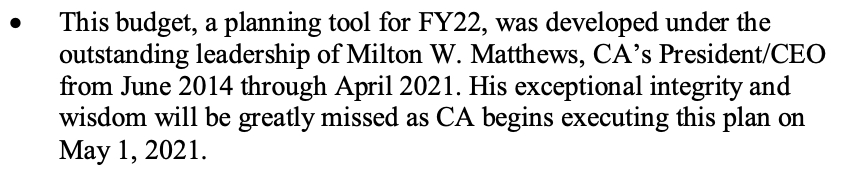
One other item about the President: Most budgets are pretty dry, but this includes the following bullet in it's "Budget at a Glance" section and I want to highlight as a reminder that this budget--and institutions like CA, more broadly--are made up of people, working together and (usually) trying their best to achieve a common goal. This item pulled back the curtain on the dry formality of the budget to let in a little humanity and I love it. 


Pictures 


Communications and Marketing

I’m a little biased about this but I find this re-org of the Communications and Marketing division somewhat confusing. If anything, CA’s marketing of its memberships has been fine—surely you see as many digital ads for the gyms and golf courses as I do—but its communications have been not so good. Indeed, I think the lack of strategic communications expertise (or the undervaluing of it) has led to a bunch of CA “own” goals over the last year.

All that said, I hope that with all these new positions in “Branding and Marketing” CA will finally start to think about the “Columbia” brand in addition to its own (they are more related than CA would like to believe). 

Sports and Fitness


CA’s proposed budget assumes sports and fitness facility usage at the end of this budget (April, 2022) to return to about 85% of pre-COVID levels across its portfolio. This seems like a fair assumption, but there is still so much uncertainty about our “new” normal and the time it will take to get there.

Sports and Fitness is poised to lose money pretty much across the board. The Columbia Gym is budgeted to “earn” about $141,000, but this is largely because of how membership revenue is allocated across the different facilities. None of this is news. 

Community Services

Did you know the Horse Center is housed in the “Community Services” budget? Why not sports and fitness? CA has a new operator but the lease revenue is considerably less than it was last year and the year before ($9,000 vs $16,000 in FY19 and $15,000 in FY20).

CA’s community grants budget is zeroed out. Compare that to almost $1 million in FY19. In less than two years, CA’s grants to community non-profits have dropped by $1 million. This is huge and an under-appreciated aspect of CA pulling back on its community focus.

While this budget line is less than 2% of CA’s spending, the impact on the nonprofits losing these grants is much bigger. For some organizations, these grants represented significant (20%+ of their annual revenue) and funded important community programs. As we look ahead to a year when “programming” will return, there are going to be many non-profits struggling to do what they were once able to without this support.

At the same time, however, CA has budgeted its own return to programming in the form of it’s Lakefront Festival (not to be confused with the Columbia Festival of the Arts' "LakeFest"). This is a more complicated matter than I can get into on a “bits” blog post, but briefly: Downtown Columbia is crowded with organizations and programs and the overlap between them has caused unnecessary strife and expense. There have been conversations about a more “collaborative” lakefront programming paradigm—one in which existing non-profits, CA, and the community can all benefit—but there is no indication of any action on that front in this budget.

But, as with everything in the budget, it is all subject to change! CA’s Board will host its first worksession on the budget tonight at 7 pm.

From CA’s Facebook page, here are the details:


Read agenda and packet: https://bit.ly/31Qi3iZ

Participate in Resident Speakout: https://bit.ly/3mtqN6s

Watch/Join meeting live on YouTube: https://youtu.be/W_a5veyf6_8


If you stand for nothing, what'll you fall for?

I spent a few hours yesterday reviewing the Columbia Association's proposed FY22 budget and (surprise) I have some thoughts. I had planned to share some of these thoughts this week, but a Facebook post from 2018 showed up in my “memories” and, well, here we are.

The post from 2018 was prompted by the anniversary of this piece about Columbia's "values" that ran in the Baltimore Sun in 2017. The Facebook post, however, went a slightly different direction: 
And though it certainly has and continues to advocate for Columbia's interests, (CA’s) silence on matters of segregation--school based and otherwise--is noticeable. Segregation is, after all, part of what spurred Columbia's founding. 

There are lots of things to unpack here--representation, mission, inclusion, funding, etc. And I don't mean for this to come off as negative toward CA--it does many tremendous things for Columbia that help improve our quality of life and further the original values. 

But there are some radical changes taking place here and across the world, and maybe the time is right for radical re-assessment of what and how CA can best serve Columbia--now and 50 years from now.
CA’s silence over the last year, as our community and nation have wrestled with matters that are very much rooted in the values of Columbia’s founding, is hard to miss. I have seen it raised in several conversations, some very recently. As I said three years ago, there are lots of reasons for this silence, and on one of the more contentious local issues related to segregation—schools—there are no clear-cut right answers.

That said, CA's persistent struggle to articulate its position on issues related to Columbia’s core value set is only becoming more apparent and glaring. One look at the "Goals" section of its proposed budget puts things starkly. These goals align with priorities approved by CA's board as part of its Strategic Plan and address five specific areas:

1. Identity
2. Resource Stewardship
3. Environmental Sustainability
4. Leadership Development
5. Advocacy

Each priority area has a clearly defined goal and a set of action items to achieve those goals. Most have between three and six specific tasks with clear outcomes and timelines. Except Leadership Development.

As you can see in the screenshot below, the goal included in the strategic priority area of Leadership Development is: "Increase participation among a demographically diverse community to serve in leadership roles on CA advisory committees, community groups, and the CA board."

That sounds pretty good, if vague, but the action item for this priority is where things really fall apart: "a. Outreach to cultural and diverse community."

If it ended there, we could chalk this up to an organization that is clumsily trying to catch up, but the next (and last) strategic priority does little to support such a charitable read: 
Strategic Priority: Advocacy

Goal: "Advocate on issues that are key to Columbia's values and are key to our future as a unique, diverse, master planned community."
It offers three tasks, the first two are mostly benign, but then there’s this:
Monitor issues in the following area for advocacy:
  • New Town Zoning
  • Environment
  • Land Use
  • Alternative Housing
  • Smart Development

That's it, a list issues that are largely centered around the local policy matters that typically excite people who are predisposed to not wanting additional development in their "back yards". (Yes, I went out of my way to avoid using the acronym that is now its own word.) 

There is nothing about social justice, racial equity, economic opportunity, education, transportation, or the myriad other issues that demand our attention if we are to realize the Columbia vision of a racially and economically diverse community living in a "complete" city where opportunities for self-advancement abound.

One wonders what would happen if CA approached its "outreach to cultural and diverse community” as energetically as it did its other advocacy areas, and if so, how would a more diverse leadership structure change the priorities of its advocacy efforts?

Kind of a chicken and an egg.

More about the budget—and even about this particular topic—soon.

Screen shot of the budget page referenced above: 


If you want a garden, you're going to have to sow the seeds

As I explained in starting this blog, my hope was to create a space for a thoughtful examination of the structure, culture, and governance of the Columbia Association. It is, as I have said before, Columbia’s most important civic institution, and despite the popularity of some of its programs and assets, its governance, operations, and finances are given little consideration by residents and businesses of Columbia.

While I still firmly believe we need to more closely and thoroughly examine CA, its history, and its structure to understand how to unleash the full potential of the institution, I also recognize that this does not necessarily make for the most compelling or engaging blog content.

The key insight here, however, is not about the interests and preferences of others, but it’s about my own biases toward institutionalism and credentialism. I’ll work on untangling those, but in the meantime, I want to write about things that are more immediate, tangible, and relevant to the lives of people who live in, work in, or simply care about the future of Columbia.

So, let’s talk about berries. Specifically, this patch of berry bushes in Stevens Forest.


At some point in the last ten years or so, the Columbia Association stopped mowing this field, allowing the natural process of reforestation to begin.

We’re in the meadow phase, and as part of this, berry bushes have proliferated (I think it’s a mix of black raspberries and invasive wineberries but I’m better at identifying trees and hawks than I am bushes and berries). 

Every June, the ripening red and black berries here attract hungry, foraging residents—both human and animal alike. It’s a wonderful scene and something I look forward to every year—these berries have become a fundamental and happy part of my experience of living in Stevens Forest.

One of CA’s biggest opportunities for improvement is to focus on experience of living and working in Columbia. If there were a big bucket wherein I put most or maybe even all of my issues and concerns with CA, you could probably name it “experience”. Columbia’s founding was full of energy, enthusiasm, and optimism because the Rouse Company put the experience of living and working in Columbia front and center in its planning, development, and marketing of Columbia. It celebrated Columbia not for the things it had but for the way those things created a complete and compelling experience.

Open space is a fundamental to the experience of Columbia. It is regularly mentioned as one of the things people love most about Columbia, and it is used by more people than any other of CA’s programs or facilities. I have written about open space before and the potential for its enhancement, which could in turn help enhance the experience of living in Columbia:

But with concerns mounting about social isolation and kids not spending enough time outside, we should consider whether Columbia’s open space can be enhanced in ways previously not considered; if it can provide a better foundation for residents to engage with nature and each other; and if its use can be expanded in ways that are compatible with our larger goals for our environment and community.

And I’d propose that naming some of the most important spaces is a first step toward this new “open space ethic.”

But a new open space ethic should be more than this; it should be about strengthening the ecosystem that encompasses both our natural and our human communities. Maybe this means replacing tot lots with something different — rock-scapes for climbing and free play, treehouses to highlight views, art installations that encourage exploration and discovery, or stormwater management projects that help reduce or clean runoff but while also enhancing the neighborhood aesthetic.

Treating Columbia’s open space network as the managed landscape it is offers a chance to think about how we improve both its ecological integrity and opportunities for people to enjoy.

So, in the realm of concrete, tangible ideas to make Columbia a better place, perhaps we should consider planting more native berry bushes, fruit trees like Maryland’s native Paw Paw, and wildflowers. 

Are there any areas in your neighborhood that are ripe for enhancement? Do you have any ideas for open space that you think could bear fruit in the years to come?


Navigating without a North Star

It’s Throwback Thursday here at the Columbia Flyer and we’re throwing it back to…. February.

I wrote the following piece in February, before the pandemic up-ended everything, and had planned to submit it as an op-ed. However, as the reality of COVID-19 start setting in, my attention and priorities shifted.

I’m sharing it now to highlight the fact that CA’s struggles pre-date the pandemic and maybe also to show that this is something I’ve been thinking about for a while.

The bottom line for me is that CA has lost its way, and its response to the pandemic and associated challenges has caused it to drift even further off course. Or: “CA needs leadership that is looking out for Columbia’s interests, not just CA’s…”

But you can read the whole thing and let me know what you think!

Columbia founder James Rouse still looms large over the “Next American City.” His name is invoked often, usually in a nostalgic callback to the halcyon days of the city’s birth when the visionary developer conducted a grand symphony of big ideas and bulldozers.

What is often missed is that Rouse’s greatest strength was not as a planner, businessman, or salesman—it was his perspective. Notably, it was his ability to be clear-eyed about problems of the day, pragmatic about potential solutions, and optimistic about our ability to collectively shape our futures. Rouse anticipated change and sought to steer it, building a city that could help its residents manage the uncertainty of change.

Unfortunately, Columbia hasn’t had this kind of leadership for many years. Indeed, over the last two decades, Columbia’s leaders—in particular, the elected members of the Columbia Association’s Board of Directors—have struggled both to acknowledge the world for what it is and to present a compelling vision for how Columbia could evolve to respond to our challenges.

Columbia was founded in the context of and in response to great social upheaval, but its leaders often seem unaware of the upheavals of the 2020s and the need for Columbia to respond.

Instead, we’re re-arranging tot-lots while society’s tectonic plates collide underneath.

The Columbia Association is not Columbia, to be sure. It is not a municipal government, and its elected directors are, like directors of all corporations, responsible primarily for ensuring the organization’s financial solvency. But CA enjoys the benefits of steady, dependable government-like revenue by way of its annual charge on all property owners, and it has none of government’s daunting responsibilities like emergency services, public utilities, or school funding.

With such a stable financial foundation, CA’s directors can and should focus on ensuring Columbia remains a great place to live, work, and play and that it reflects the essential values embedded in the community’s bedrock. But when faced with opportunities to guide Columbia’s future with visionary leadership, CA’s directors have abdicated these responsibilities.

For instance, starting in 2005 residents of Columbia engaged in a years-long community dialogue that lead to a new master plan for Downtown Columbia. Motivated largely by reflexive opposition to new development, CA’s directors at the time removed the organization from the planning conversation, losing leverage and a critical opportunity to help shape a master plan that would guide development of Columbia’s urban core. That plan was passed ten years ago and the Columbia Association is mentioned less than a handful of times in it, leaving the organization with almost no role or influence in the future of Downtown Columbia.

More recently, the conversation in Howard County turned to economic and racial segregation in our neighborhoods and public schools, particularly those in Columbia. While the school system’s redistricting process was incredibly contentious, an essential component of Columbia’s identity is integrated schools. And for CA, the organization founded to further the Columbia way of life, to remain silent on a matter that is essential to Columbia’s identity is a rejection of its own foundational purpose.

These are large examples, but the small ones are everywhere too. CA’s most recent capital improvement projects include an exclusive and expensive wellness retreat, a new clubhouse and restaurant at one of its golf courses, and an indoor tennis club. Not only are these risky investments in the rapidly changing fitness market, but none of these projects helped to address ongoing disinvestment in Columbia’s older villages and village centers, an opportunity lost.

What makes this especially frustrating is that CA is full of friendly, dedicated team members who take pride in their work and their community. From the operations crews to the lifeguards to the division chiefs and executives, CA staff are exemplary ambassadors for the organization and the community.

And to be sure, there are members of the board of directors who work as diligently as its staff in spite of the myopia of their colleagues. But even best board member will get bogged down in the morass of unnecessary meetings, busywork, and intra-board conflicts that have come to characterize the board’s operations.

CA has such great potential to reposition Columbia as a vanguard for how suburban life can be reimagined in the 21stcentury, a place that recaptures some of the optimistic zeitgeist of its founding, renewed for a time of even more social, political, economic, and environmental upheaval. Instead it is adrift, rudderless in ever-changing seas.

The solution is within reach, however, and it is not especially complicated. CA needs leadership that is looking out for Columbia’s interests, not just CA’s, and who recognize that this is a city that was built to anticipate change and foster positive solutions for society’s challenges.

James Rouse can no longer point to the path ahead for Columbia. And unfortunately for now, neither can CA.

Symphony of Lights

I started writing this blog as a way to get out of the day-to-day. My relationship—personal and professional—with the Columbia Association and its people is complicated, especially now. In the last couple years, it has become increasingly contentious. 

Conflict changes your perspective—it demands a narrower focus and leaves lots of space for emotions (which can be good and bad). 

So this blog is meant to be a place where I leave the conflicts of daily life behind and broaden my focus—to write considered, thoughtful and analytical pieces about something—the Columbia Association—that I am passionate about. I believe as strongly as ever in the purpose and the potential of CA, and I believe that its current predicament is a critical crossroads that demands our attention and energy. 

CA is Columbia’s most important civic institution, and the decisions its leaders make over the next year or two will have profound and lasting impacts on CA and Columbia for many years to come.

The Symphony of Lights op-ed is, contra this blog’s purpose, about the day-to-day (year-to-year?) conflict, a portion of it anyway. I have mixed feelings about calling CA the Grinch, but I have no such hesitation about the need to tell this story in this way. 

Because it is part of the larger story about CA, where it stands in these extraordinary times, and how it plots a course for its future. To be blunt: I think the Columbia Association has lost its way.

I want only the best for Columbia and the Columbia Association. Sometimes that means writing lengthy pieces about committee structures (stay tuned!) and sometimes that means embracing the starkness of the conflict. 

Symphony of Lights will turn on or it won’t. For these lights, there is no dimmer, nothing between on and off.

CA: Columbia Apathy

Institutions are shaped by many forces, and this is true of the Columbia Association. One of the stronger forces that has influenced CA and its politics over the years, however, is one of absence and omission—namely, indifference, or perhaps more fittingly, apathy.  

Indifference is a silence that can be mistaken for consent or contentment, and a force that creates a vacuum that those with specific or narrow interests can fill for their own ends. And they have, and we’ll talk more about some of those interests later.


For now, we’ll focus on the lack of interest. 


In a community that is as informed, engaged, and active as Columbia, the broadly shared apathy towards CA is curious. When I first got involved in the community, I joined and eventually chaired the Columbia Association’s Environmental Matters subcommittee in the early 2000s and our staff liaison at the time made a joke that’s stuck with me: Community meetings are the official pastime of Columbians.


While that’s not entirely true, it’s not wrong. We love meetings, and we have many of them in our community. Indeed, many Columbia residents are involved and engaged in a variety of community matters, but aside from periods of upheaval or controversy, engagement with the governance of CA and participation in Columbia elections is and has always been relatively low. 


Even going back to the early 1980s, around the time a grassroots community movement successfully managed to wrestle complete control of CA from the Rouse Company, newspaper articles detail and editorials bemoan elections that failed to meet the minimum quorum of 10 percent of eligible voters. Village managers at the time threw parties and gave away free beer to get more participation, but they were largely unsuccessful, even when the founding zeitgeist of Columbia was still in the air.


It’s true that at the time the biggest matter affecting CA—financing—was somewhat obtuse, but this has been true of CA throughout the decades. Elections struggle to reach quorums and the CA board, while once having received generous coverage from local papers, operates in a manner that is at least somewhat disconnected from the community itself. Which is, in some ways, fitting because the structure of CA is such that the only real “members” of the organization are the members of the board. The rest of us are just leinpayers and residents.   


I had long assumed that Columbia’s glory days were defined by greater involvement with CA governance and politics, and while I think that assumption is part true, it is more false than not. 


While CA generally enjoys broad awareness, many people are unclear about what it does and who runs it. Indeed, a survey conducted in the 1990s found that only 21 percent of Columbians knew it was governed by an elected Board of Directors and I would surmise the number is about the same today. It’s no wonder, then, that most aren’t engaged with the politics of it.  


Many early writers posited that this was complacency—Rouse gave Columbians everything they ever wanted and they got fat and happy. Maybe it was complacency once, but that complacency has clearly given way to apathy and indifference, except in a few specific instances or from a few specific constituencies.


And I think CA’s leadership is generally happy with the state of affairs. Those who are elected can maintain power by engaging the small constituency that elects them and ignoring—either willfully or by omission—the overwhelming majority of Columbia residents and lienpayers who don’t engage. 


CA doesn’t generally hold public hearings, setting aside only 15 minutes each meeting for “Resident Speakout;” it doesn’t promote village elections in a meaningful and deliberate way; until the pandemic, its meetings were not broadcast publicly; it rarely uses its communications channels to talk about its governance; and throughout this pandemic has made drastic cuts to its programs and services without any real engagement with the community it serves.


In short, the Columbia Association indifference seems to be a two-way street. A community that is indifferent to the institution that is supposed to be serving it, and an institution that is indifferent to the community it is supposed to serve. 


And a cycle that has repeated itself decade after decade.


Of course, not everyone is apathetic about CA. And those who aren’t have leveraged this imbalance effectively. 

What's in CA's DNA?

When last we wrote, the question of what the Columbia Association is led us to what it was supposed to be. 

Interestingly, unlike Columbia itself, the association created to promote the social welfare of Columbia did not seem be to imbued with the same core set of values in its founding.


Which is to say, CA was not necessarily created to be the “keeper of the vision” or the institution tasked with tending the “garden for growing people,” and without that charge among its first principles, what is it? 


Indeed, with hindsight, it seems that CA was largely created out of expedience. Jim Rouse knew the Howard County Commissioners of the time would have no interest in funding recreational and community facilities in this new city he was building. He also knew that his company and its financial backers alone could not fund everything promised in the grand Columbia vision. 


Enter CA. By placing a lien on every property owned by the Rouse Company as part of the Columbia project, CA would collect annual assessments to fund its operations and the costs of construction of the facilities envisioned in Rouse’s plan. As the community grew, so would CA’s finances, allowing early debts to be repaid in time.


CA was, therefore, a financing vehicle to support Columbia’s growth, a point made clear by the fact that CA was fully controlled by Rouse for its first decade-plus of existence. 


This framework led to the first big effort at reforming CA, but we’re getting ahead of ourselves.


In the early days of Columbia, CA lost money every year and took on lots of debt to build facilities for the community, which was very small at the time and which could not fully support the costs of CA’s operations and construction. 


The oil crisis and economic slowdown of the early 1970s slowed the pace of construction in Columbia and caused all sorts of financial trouble for CA and Rouse. They both weathered the storm, but CA’s debt ballooned and residents of the young community grew increasingly concerned about CA’s debt load, which was compounded by annual operational losses. This set up the first real political fight about CA.


CA’s foundational documents include no reference to Columbia’s values of inclusivity, optimism, sustainability, or more. Instead, they speak of the Columbia Parks and Recreation Association existing to engage in any manner of development, construction, or operations that the Rouse Company choose, so long as it conformed with a broad definition of supporting community welfare. Indeed, among other things, the original CPRA deed allows for the entity to construct an airport and pretty much anything else deemed “necessary and desirable” by its Board. 


So, if CA was supposed to build and operate facilities, who was nurturing the social well-being of the community?  


A story I’ve heard is that Jim Rouse established the Columbia Foundation (now the Community Foundation of Howard County [CFHoCo]) early on as an entity to promote community philanthropy and support social services. 


CA, therefore, handled recreation and amenities and the community foundation would weave together the fabric of social services necessary to support a racially and economically diverse community.


While CFHoCo has grown to become a sizeable and effective community foundation, engaging thousands of residents in philanthropy and supporting many worthy organizations and initiatives over the last 50 years, it is dwarfed by the CA in terms of size, financial resources, and reach. 


And so now in 2020, as the foundational values that form the essence of this “garden for growing people” demand our attention and effort, who is the true steward of those values? Who is tending the garden, tilling the soil, ensuring that Columbia’s fundamental purpose for being—to be a city that nurtures love—is being met? 


CA proclaims itself to be the keeper of that vision, but that vision is being strained in many ways and what is CA doing to ensure it holds strong? 


Columbia’s schools have grown increasingly segregated in recent years, which is in direct conflict with the Rouse’s founding vision. What has CA done to address this alarming trend?


Many of Columbia’s neighborhoods are struggling with disinvestment and negative, often racist perceptions. What has CA done to affirmatively reject stereotypes and reinvigorate these neighborhoods?


Where was CA in the planning for Columbia’s Downtown? Rather than approach a conversation about Columbia’s future with openness and optimism, CA’s directors in the mid-200s at removed the organization from the planning conversation, largely in an effort to stall or stop any development, and in so doing lost leverage and a critical opportunity to help shape a master plan that would guide development of Columbia’s urban core. That plan was passed ten years ago and the Columbia Association is mentioned less than a handful of times in it, leaving the organization with almost role or influence in the future of Downtown Columbia.


Or, going back longer, where was CA when River Hill was built without apartments? When Dobbin Road and Snowden River Parkway became retail centers, robbing village centers of tenants and business?


You could ask many more questions like these and still arrive at the same conclusion, one which seems a hallmark of Columbia. The truth is that CA picks and chooses when it engages in the work of nurturing Columbia and when it engages in the work of supporting itself for its own sake because it wasn’t created with a clear focus—the values of Columbia were not baked into the organization’s DNA, and so it’s been shaped by interests and forces with other aims. 


For more on how CA has been shaped over the years, we need to examine the cultural and political dynamics surrounding CA governance and politics.  

Identity

The Columbia Association’s identity crisis is almost as old as the organization itself.

Misperceptions about CA, what it does, how its funded, and who it serves abound, and in the absence of a strong, compelling, and cohesive identity for CA, these misperceptions often manifest in the community as confusion and indifference. 


Here’s my most basic definition: The Columbia Association is a community services organization funded by a combination of a tax-like “Annual Charge” assessed on each property and earned income, and it is governed by a Board of Directors elected by members of affiliated associations. It manages community facilities, programs, and thousands of acres of open space for benefit of people who live and work in Columbia. 


Unfortunately, this is a technical answer to a question that demands more, a question that shapes and defines the organization itself. 


On some level, this question of uncertain identity is inherent to an entity like CA, which resembles a lot of things but doesn’t fit into any one bucket. 


On the surface, it seems to most closely resemble a homeowner’s association and is, in fact, considered one in state law, but that’s a bad description for a few reasons. Notably, CA (and the affiliated village associations) explicitly serves all residents, owners and renters alike, as well as those who own or are employed by businesses located in “Columbia.”


Also, CA doesn’t give a hoot what color you paint your door. That’s the villages (and some of them really care). 


So if it’s not exactly an HOA, what is it? From the IRS’s perspective, it is a 501(c)4 social welfare organization, which is a broadly defined category of tax-exempt, “not-for-profit” corporations that operate exclusively to promote public welfare but that don’t quite fit the traditional, 501(c)3 charity mold. A notable drawback of this status for CA is that it is unable to accept tax-deductible donations and is excluded from many grant funding opportunities. 


But identity is more than legal distinctions. It is perception, reputation, and also the secret, often unknowable, and increasingly important sauce of emotional bonds between an organization or an institution and those it serves.  


In its almost 55 years of existence, CA has been many things to many people—an arm of a developer; a bully pulpit for neighborhood busybodies, an impenetrable and sometimes shadowy bureaucracy, a community leader, a major local employer, a convener, a fitness business, an event planner and community programmer, a grant-maker, an HOA, and many other labels, concepts, perceptions, and misperceptions. 


Got all that. Anyway, here’s what CA says about itself in a letter from its President on its website:


Despite the breadth and variety of our services, what makes Columbia truly special is an ongoing commitment to the vision espoused by James Rouse, our founding father. As he stated, “By creating the image of the rational potential of a city, we generate the power to carry it forward. Without vision, there is no power.” At Columbia Association, we consider ourselves keepers of Columbia’s vision.
 
In support of this vision, Columbia Association offers a vast array of recreational, cultural and community services. 
 
In addition, CA maintains nearly 3,600 acres of open space as a permanent asset for residents. Neighborhood amenities include lakes, parks, tot lots, basketball and tennis courts and 95 miles of walking, jogging and biking pathways.

We will talk more about the idea that the Columbia Association consider itself keeper of “Columbia’s vision.” 


But first, we still need to get some definitions right. “Community services corporation” raises an important question: What is a community service? 


Clearly, managing Columbia’s open spaces is a community service. Is providing tot lots and outdoor play spaces? Probably. Running community programs like a Teen Center, Lakefront events, and Art Center? Sure. Outdoor pools? We’re starting to get into a gray area of private/public use, but I’ll go with it. Fitness clubs? Golf Courses? A “wellness retreat”? 


Yeah, see, you start the pull the thread and there’s no telling where it stops. 


Why does it matter? It matters because you need a solid sense of what you are and what you stand for when faced with complex questions and problems that challenge your values and conception of who you are. 


For instance, when faced with a pandemic and economic upheaval that will close facilities and end programs, what do you choose to save and what do you shutter? Or, less severe: what do you prioritize and protect first? CA has made those priorities clear over the last few months as fitness clubs and golf courses have opened while community services and programs have been abandoned. 


Perhaps, then, the question of CA’s identity comes down to priorities. In that sense the pandemic has boiled the identity question down to this: Is it a community services organization hoping to salvage its struggling fitness business, or a struggling fitness business trying to preserve itself by scuttling community programs and services?


We have lots of questions, a few answers, and still a lot of uncertainty about CA. So, maybe the real answer lies in the question: What was it supposed to be? 


Stay tuned.

Nuts and Bolts

I have no clue what frequency I’ll be writing, but my hope is to dedicate a couple hours each week to writing. Whether these will be fruitful hours or not is and will remain for some time an open question. So, expect a post a week, maybe two. The next post will come out on Monday. 

My plan is to keep posts between 500-800 words. Long enough to delve below the surface of a particular question or problem, but not so long as to make every post an exposition. Putting a cap on word count will help me keep posts focused. One of the biggest challenges I have faced in trying to think and write about CA is that it can become an expansive conversation, with many intersecting threads that go back decades. Rather than one long manifesto, this will make writing, reading, and discussing more manageable. 


It will also allow me to reflect on feedback I receive. While I’ve done a fair amount of research in the last few months—reading old newspaper reports, legal documents, and other archived materials—I know there is much I have missed, nuance and context that have been lost in time. 


So I encourage conversations about the posts or about this effort more broadly. For that reason, I have opened comments on the blog, but you can also comment to me on twitter (@iankennedy7), on the Columbia Flyer facebook page, or you can send me an email (handle is the same as twitter, but put a “.” between my first and last name and address @gmail). 


Finally, because I have to say it, everything I write here reflects my personal beliefs and opinions, and not those of any other person or entity. Obviously, I have inherent biases that anyone is welcome to question.


But this blog and my writing is a good faith exercise in community dialogue and an attempt to add perspective, context, and information to a matter—the governance and future of the Columbia Association—that has not been subject to sufficient consideration and conversation. During the first few decades of CA’s existence, its actions and deliberations were exhaustively covered by multiple regional and local newspapers. These days, you will generally only see the Columbia Association in the newspapers as an advertiser.


I am not suggesting that I can fill that information void, but I hope to close it at least a little. 

A New Direction

I have a potentially unhealthy obsession with something no one else seems to care about: the Columbia Association. 


It is not entirely fair to say that no one else seems to care much about the Columbia Association. The truth is that most people don’t care, but a small number of people really, really care. And I am one of them.


This dichotomous dynamic—community-wide complacency combined with narrow, intense interest from a select few—has characterized the Columbia Association’s governance and politics for almost its entire existence. How and why it got this way and what to do about it are the questions I hope to confront on this blog over the next few weeks, months, years, whatever.


Despite some high-profile disagreements with CA and members of its leadership over the years, however, I’m not embarking on this work out of spite, professional obligation, or personal animosity. (At least I don’t think I am, but we’re all selfish beings with fine-tuned engines for motivated reasoning so who really knows what underlies any of our actions?) 


I am writing because of a long-held conviction that CA can be so much better than it is. 


That’s a pretty vague statement and it could mean all sorts of things. Anyone who’s followed CA over the years also knows that making it “better” has been the rallying cry of the most significant—and, more or less, only—community advocacy organization focused on CA, the Alliance for a Better Columbia. 


So, I should clarify what I mean by “better.” Columbia is a special city founded on a set of lofty, aspirational ideals and CA is the only organization that exists expressly to promote the social welfare of this city. While Columbia continues to be a great place to live and work, it has evolved from its early days and faces challenges—both local and global in scale—that call into question the foundational values upon which it was built. 


A better CA, therefore, is one that recognizes its unique role as a steward of the ethos, values, and aspirations of Columbia’s founding; it is one that examines its place within the cultural, social, and political currents of the day and asks whether its actions embody the core values of the organization and the community it serves; and it is one that questions its institutional structures, biases, and blindspots to ensure its practices and programs are not undermining its own mission; and it is one that proactively seeks to include voices and viewpoints that are or have been underrepresented among its leadership.


In short, a “better” CA is one that pursues the aspirations of Columbia’s founding and holds itself accountable to those values and ideals.


It is the only institution that is truly dedicated to this “garden for growing people” and my contention is that it is currently failing to live up to this critical role. 


Amidst the howling social, cultural, economic, and political winds of our time, CA is unmoored and adrift, uncertain about what it is or what it should be. This predicament became even more precarious in the last six months as the pandemic brought on dire, existential questions. In answering these questions, CA’s leaders choose to prioritize re-starting its fitness businesses, which serve “members” and “customers,” while abandoning most of the community programs and services that are available to all residents. 


During the greatest disruption in social and community life in CA’s existence, it chose business over community, and this, in my mind, the most glaring example of why Columbia needs CA to be better. 


However, before CA can be the better organization that I know it can be, there needs to be a shared literacy about what it is, how it got here, what it does, and what it can be. 


Consider this a spotlight, dim as it is, to help illuminate and understand the path we took to get here, the intersection where we now stand, and the divergent paths that lie ahead. 

Can we talk?

When I launched this blog three weeks ago, I shared the first post on Facebook thusly: “A blog. A more quiet place to write. Maybe a flight of fancy, maybe something more.”

With time, it’s looking like the former.

Something that seems characteristic of blogging is the peek behind the curtain; the personal details/excuses about why the blogger hasn’t written enough or whatever. I’m trying to avoid doing that here, even while I’m clearly hinting at it.

To the extent I’ll get into more personal or the intersection of personal and professional stuff, I hope to do it in the context of issues and not as tortured rationalizations or idle naval gazing. I should stop doing both.

I expect much of whatever writing I do will deal with growth in our community, how we talk about it, and how we can embrace the opportunities it presents. It’s a complicated and charged subject—especially now—and I hope to be able to add some context and perspective to the discussion. I’ve spent most of my adult life in the thick of community development matters, and while I clearly have opinions and biases, my bigger aim is to help find ways to have better conversations about it. 

Because right now, the way we talk about development and growth is… not good. Not that it ever is, but the confluence of a new wave of activism, acute crowding in some of our schools, and the upcoming elections has pushed nuance out in favor of sloganeering and motivated reasoning, with a side of Dunning-Kruger.

I appreciate that Julia at Village Green/Town² stepped into the breach yesterday with her post “The Sweet Spot”, which wrestles with the seeming intractability of this conversation:
On the one hand, I know what communities look like when businesses feels that they are no longer commercially viable. Developers are no longer motivated to engage. It can be a vicious cycle. A lack of willingness to invest can be the kiss of death. And I know that we need a push for affordable housing and decent “starter” housing. We need to make that a priority. 
On the other hand, I do see quite clearly the overcrowding in schools that continued development has brought to our area. It seems logical to suggest that the pace of new housing should be slowed while new school construction is sped up. There are legitimate environmental concerns. And do developers pay an amount that is a meaningful contribution?  
...  
My conversation about development the other evening made me realize how much I want to find common ground between these two sides. What is the sweet spot between continued investment in Howard County and protecting and supporting infrastructure, services, amenities, schools, etc? It simply can’t be an either/or proposition.
It seems to me that we’ll only find that common ground when we can collectively share a common set of facts and a baseline understanding of the complexity of growth, development, and all of the intended and unintended consequences of the laws, regulations, programs, and actions we take as consumers in the real estate market and as advocates in the public sphere (collectively, “the system”).

Which brings me to something I’ve wanted to share for weeks: an article in Urban Land about Downtown Columbia called “Urbanizing the Town Center of Columbia,Maryland

As you can tell, this is written from the perspective that development is, in general, good, but if you can look past that, you’ll see that the planning and re-development of Downtown Columbia was not a hasty developer giveaway at the expense of the community. It was, and is, a process that spanned more than a decade and three Howard County Executives, involving an ongoing approval process that is lengthy, deliberate, and includes numerous opportunities for public participation.

And it is also a reflection of the tension between public values and private enterprise, a tension that rests at the heart of our growth conversations. The Downtown Columbia Master Plan balances this tension with entitlements and obligations, processes and policies, give and take. Whether it struck the right balance is, of course, debatable.

If you have not done so, I urge you to read the piece. It is comprehensive and fair, even if slanted in favor of development. Moreover, it provides insight into what it takes for a developer to take an approved plan and translate it into actual projects. Development finance and the process it takes to get a shovel in the ground is, I suspect, something that few of us fully understand.

Julia’s post yesterday ended with a quote from a mutual friend of ours about the “tyranny of the OR” and the pervasive scarcity mindset. Look around and you see this everywhere in our society today. I, too, support the idea of the “genius of the AND,” and I think what we’ve done in Columbia over the last 50 years and Downtown Columbia over the last 15 reflects that.

I don’t, however, feel that this view is shared very widely. But I’m not here to convince you to think like me, but I do hope that through better conversations and some mutual curiosity, we can start looking at the challenges posed by “or” as opportunities for an “and".

My Speakout

As much as I don't like the term "Resident Speakout" that's what it is. What follows are the remarks I delivered at last n...